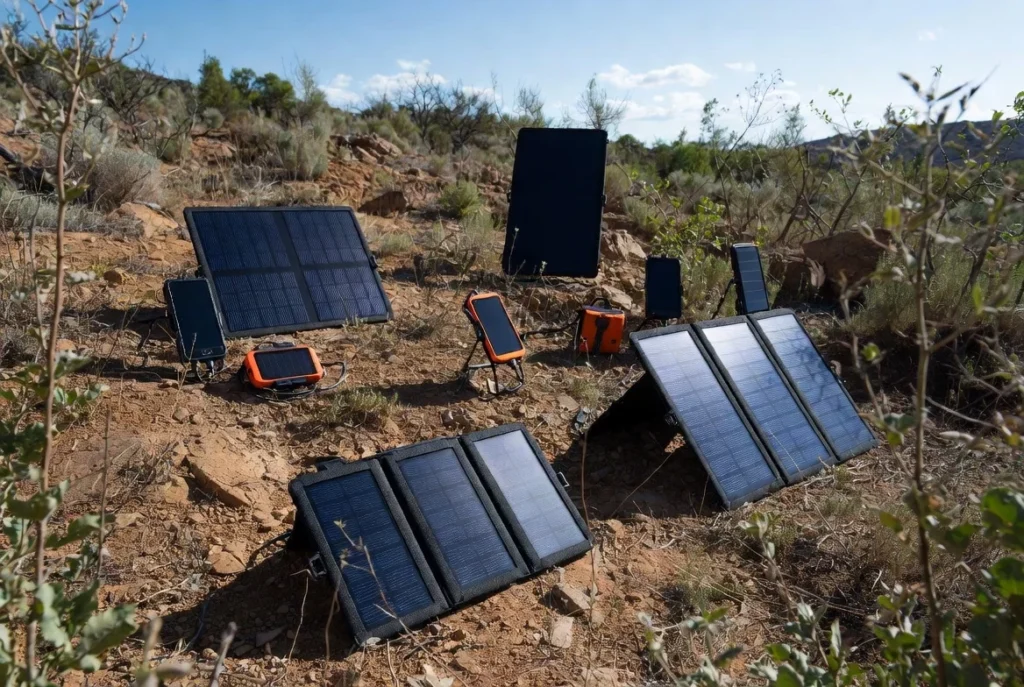
Last summer, a friend of mine went on a 4-day hiking trip. On day two, his phone completely died. As a result, he had no map, no emergency contact, and no way to call for help. Fortunately, he made it back fine. But he told me afterwards: “Never again without a solar charger.”
That one story is, honestly, the best reason to own a solar power bank.
Whether you camp on weekends, travel frequently, or simply want something reliable during a power outage, a solar power bank is worth considering. Unlike regular power banks, it gives you one extra advantage: a way to recharge even when there is no outlet in sight. In other words, you are never truly stuck.
Let’s break it all down simply.
What Is a Solar Power Bank, Really?
Think of it as a regular power bank with a small solar panel attached.
During the day, that panel soaks up sunlight and slowly fills up the battery inside. At night, or whenever you need it, you use that stored energy to charge your phone, tablet, or any USB device.
One thing to be honest about upfront: the solar panel on most portable units is small. It won’t fully recharge itself in a few hours. But it will keep topping up throughout the day, which can add hours of extra battery life to your devices. For camping or emergencies, that matters a lot.
What to Look For Before You Buy
Battery Size (mAh)
This tells you how much power it stores. A quick reference:
- 10,000mAh charges most phones 2 times
- 20,000mAh charges most phones 4 to 5 times
- 26,000mAh+ is great for multi-day trips or charging multiple devices
For emergencies or camping, don’t go below 20,000mAh.
Solar Panel Quality
More panels usually means faster solar charging. Look for 4 panels if possible. Also check if the brand mentions conversion efficiency anywhere, 20% or above is decent for a portable unit.
Waterproof Rating
Always check for an IP rating. IP65 keeps out dust and light rain. IP67 means it can handle being submerged briefly. For outdoor use, you want at least IP65.
Charging Speed
Look for USB-C with at least 18W output. Faster charging means less waiting. If you carry a laptop, some models go up to 65W.
Ports
At minimum, you want one USB-C and two USB-A ports. That covers most people’s devices without any juggling.
Best Solar Power Banks Right Now (2026)
1. Anker PowerCore Solar 20000
Best for: Travelers and weekend campers
Anker makes some of the most reliable charging gear on the market, and this one lives up to that reputation. 20,000mAh capacity, 20W USB-C output, and a clean lightweight design.
The solar charging is slow, as it is on most portable units, but the battery itself charges fast via USB-C and holds its charge well over time.
Good for: Anyone who wants a dependable, well-built option from a brand they can trust.
Not ideal for: Extreme outdoor conditions, no IP rating on the base model.
2. Hiluckey 26800mAh Solar Charger
Best for: Emergency preparedness
This is probably the most popular emergency solar charger in its price range, and for good reason. IP67 waterproof, four solar panels, four output ports, and an SOS flashlight built in.
It’s a bit heavier than other options, but if this is going into an emergency bag or a camping pack, that weight is worth it.
Good for: Power outages, disaster prep kits, multi-day camping.
Not ideal for: Ultralight backpackers counting every gram.
3. BigBlue 28800mAh Portable Solar Charger
Best for: Multi-day hikes
Increased capacity, two solar panels instead of one, and a durable design that endures well in the field. The dual-panel setup is effective in increasing solar top-up speed compared to single-panel competitors.
It has a built-in flashlight too, which is always a nice bonus when you’re setting up camp after dark.
Good for: Long outdoor trips where you need maximum capacity.
Not ideal for: Casual travel, it’s on the heavier side.
4. Blavor 20000mAh Wireless Solar Power Bank
Best for: Everyday travelers
The Blavor adds wireless Qi charging, which is a genuinely useful feature if your phone supports it. It also has compass functionality and a solid IP65 rating.
Wireless charging is slower than wired, but the convenience factor is real. Just set your phone on top and walk away.
Good for: Travel, daily carry, people who hate cables.
Not ideal for: Fast charging needs.
5. Goal Zero Sherpa 100 PD
Best for: Serious outdoor adventurers
This is the premium option. Pair it with Goal Zero’s foldable Nomad solar panels and you get real, usable solar input, not the slow trickle most built-in panels deliver. 100W USB-C output means you can charge a laptop properly.
It costs more, but if you’re doing serious off-grid trips, the performance difference is noticeable. You can check out their full lineup at Goal Zero’s website.
Good for: Extended off-grid trips, powering laptops and larger devices.
Not ideal for: Budget-conscious buyers.
FAQs
Are solar power banks actually worth it?
Yes, as long as you go in with realistic expectations. The solar panel is a bonus feature, not a miracle. The battery itself is what powers your devices, and solar keeps that battery alive longer. For outdoor use and emergencies, that combination is genuinely useful.
How long does solar charging take?
On a bright sunny day, most units take 25 to 50 hours of direct sunlight to fully charge via solar alone. That sounds like a lot because it is. Use USB to charge it before your trip, then let solar maintain it while you’re out.
Can it fully charge my phone?
Yes, easily. A 20,000mAh bank can charge most smartphones 4 to 5 times. The solar panel alone is too slow for direct phone charging, but the stored battery power works just like any other power bank.
Is it good for power outages?
Absolutely. Keep one charged at home and it covers your phone, a small lamp, and other USB devices for days. It’s one of the smartest things you can add to a home emergency kit.
Which one should I get?
Quick answer:
- Tight budget, want reliability: Hiluckey 26800mAh
- Travel and everyday use: Anker PowerCore Solar
- Serious camping: BigBlue or Goal Zero
- Emergency kit: Hiluckey, hands down
Final Thoughts
You don’t need to spend a fortune to get a good solar power bank. What you need is one that matches how you actually use it.
If it’s for camping weekends, the Anker or BigBlue will serve you well. If it’s sitting in an emergency bag, go with the Hiluckey and its rugged IP67 rating. If you want the best performance money can buy for real off-grid use, Goal Zero is in a league of its own.
One last tip: charge it fully before every trip. Don’t rely only on solar. Use the sun to extend its life while you’re out, not to replace proper charging at home.
And if you’re into well-built gear for outdoor use, you might enjoy this guide on best microbrand watches too, simple, reliable tools that just work.