Walk into any electronics store, and you’ll see wireless earbuds priced anywhere from $20 to $400. The real question isn’t about price, it’s about what you’re actually paying for.
Here’s the straight answer: AirPods are Apple’s specific brand of wireless earbuds with seamless Apple device integration, while earbuds is a broader term covering any small in-ear headphones from various manufacturers. Think of it like this – all AirPods are earbuds, but not all earbuds are AirPods.
The global wireless earbuds market reached $27.5 billion in 2024, according to IMARC Group, with Apple maintaining roughly 17% TWS market share in Q2 2024. Understanding what separates AirPods from the pack helps you make smarter buying decisions.
What exactly are AirPods?
AirPods represent Apple’s wireless audio solution. Launched in 2016, they’ve revolutionized Bluetooth connectivity over the past decade.
These wireless earbuds pack Apple’s proprietary H1 or W1 chip. That’s what creates instant pairing magic.
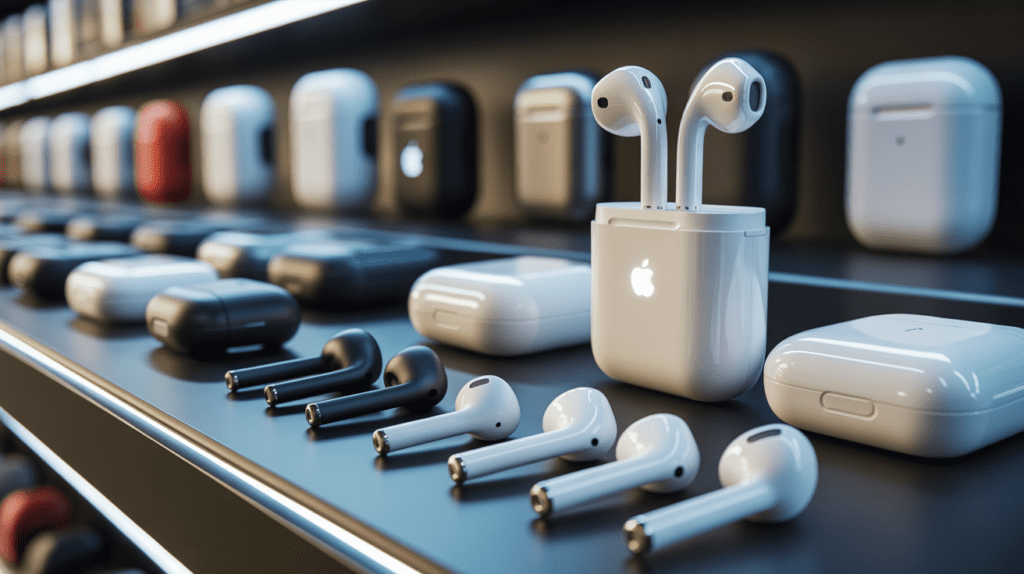
The design is instantly recognizable with that signature white stem. AirPods Pro brought silicone tips and active noise cancellation in 2019. As of early 2026, the latest AirPods Pro 2 retail for $249 while standard AirPods 3rd generation sit at $179.
Battery life delivers approximately 5 hours per charge. The charging case extends total usage to 24 to 30 hours. Newer versions support wireless charging, adding convenience to the experience.
Gesture controls let you tap or squeeze the stems to answer calls, skip tracks, or activate Siri. Water resistance with an IPX4 rating means sweat and light rain won’t destroy your investment during workouts.
Understanding regular earbuds
Earbuds encompass dozens of brands and hundreds of models. Samsung, Sony, Jabra, and Anker produce wireless earbuds at every price point from $20 to $400.
Design variations tell different stories. Some brands like Nothing copied the stem approach. Others like Sony’s WF-1000XM5 use compact designs that sit flush with your ear.
Sound quality varies dramatically. Budget options like the $50 Soundcore Life P3 handle podcasts just fine. Mid-range picks around $130 deliver impressive clarity. Premium Sennheiser models rival studio-grade headphones.
The real advantage: universal compatibility. Generic wireless earbuds connect to any Bluetooth device, whether an iPhone, Android, laptop, or gaming console, without losing functionality.
Battery performance spans a wide range. Budget options deliver 3 to 4 hours per charge while premium models push 8 hours. Total battery life reaches 20 to 40 hours with charging cases.
Key differences that actually matter
Ecosystem integration versus universal compatibility
AirPods shine within the Apple ecosystem. Automatic device switching between iPhone, iPad, and Mac happens seamlessly. Spatial audio creates immersive listening for compatible devices.
Regular earbuds work everywhere without restrictions. If you use multiple operating systems, universal earbuds make practical sense.
Price and value comparison
AirPods Pro 2 at $249 represent a significant investment. Jabra Elite 85t delivers excellent noise cancellation for $180. Anker Soundcore Liberty 3 Pro provides impressive sound at $130.
You’re paying for Apple branding, seamless integration, and distinctive design. Statistics show 68% of AirPods owners cite comfort and convenience as primary purchase motivations.
Feature showdown across price tiers
AirPods Pro bring active noise cancellation and transparency mode. Adaptive EQ automatically tunes music to your ear shape. Find My network helps locate lost earbuds using Apple’s device network.
Competing earbuds often match these features at lower prices. Sony WF-1000XM5 leads noise cancellation tests. Samsung Galaxy Buds 2 Pro offers spatial audio for Android users.
Budget earbuds sacrifice advanced features but deliver wireless freedom. The $50 tier includes Soundcore Life P3 with basic ANC and customizable EQ through companion apps.
Sound quality and comfort reality
Let’s talk honestly about AirPods’ sound. They deliver solid, balanced audio that makes most music sound good. But here’s the truth audiophiles whisper: dedicated audio companies like Sennheiser and Sony produce earbuds with richer bass, crisper highs, and better instrument separation at comparable prices.
AirPods prioritize convenience over perfection. For most people streaming Spotify during commutes or watching Netflix before bed, that trade-off feels right. The sound quality never distracts – it just works.
Comfort tells a more personal story. Standard AirPods use a one-size approach that either feels perfect or falls out constantly. There’s rarely middle ground. AirPods Pro switched to silicone tips in three sizes, which solved the fit problem for many users who struggled with the originals.
Regular earbuds offer something AirPods can’t: variety. Different brands are designed for different ears. Wing stabilizers that lock during runs. Memory foam tips that mold to your ear canal. Shallow-fit options for small ears. If AirPods never felt right, chances are excellent you’ll find earbuds from another brand that fit like they were custom-made.
When should you buy AirPods?
AirPods make perfect sense if you’re deeply invested in the Apple ecosystem. When you own an iPhone, iPad, and Mac, the seamless integration justifies the premium. Automatic switching and Siri access create convenience worth paying for.
You value design and brand perception. AirPods became a status symbol with a distinctive look. Simplicity also matters – they work brilliantly right out of the box with zero configuration for Apple users.
When generic earbuds serve you better
You use multiple device ecosystems. Android phone, Windows laptop, gaming console – universal Bluetooth earbuds connect to everything without losing functionality.
Budget constraints guide your decision. Excellent wireless earbuds exist at $50 to $120, delivering 80% of premium features at 40% of the cost. Sound quality ranks as the top priority for audiophiles who need superior driver technology.
Smart choice for 2026
The AirPods versus earbuds decision boils down to ecosystem, budget, and priorities. Apple users wanting seamless integration find genuine value despite higher prices. Everyone else discovers incredible options matching or exceeding AirPods features at a better value.
Apple sold 66 million AirPods in 2026 with over 100 million active users worldwide. Understanding your personal priorities guides you toward the right purchase.
Test before buying whenever possible. What sounds amazing in store might annoy you after long sessions. The wireless audio market continues to explode with innovation, bringing better battery life, improved noise cancellation, and enhanced sound quality across all price ranges.
FAQ’s
Which is better, earbuds or AirPods?
AirPods are better if you’re deeply invested in the Apple ecosystem with iPhone, iPad, and Mac, offering seamless device switching and instant pairing. Generic earbuds are better for Android users, multi-platform compatibility, and budget-conscious buyers who want excellent sound quality at 40% lower prices.
Are EarPods and AirPods the same thing?
No, EarPods are Apple’s wired earphones that connect via Lightning or 3.5mm jack and cost $19, while AirPods are wireless earbuds using Bluetooth connectivity starting at $179. AirPods offer wireless freedom, longer battery life with charging case, and advanced features like active noise cancellation that EarPods lack.
Which is better, buds or pods?
“Pods” typically refers to AirPods specifically, while “buds” means any wireless earbuds from brands like Samsung, Sony, or Jabra. AirPods excel for Apple users with seamless ecosystem integration, while other wireless buds offer better value, universal compatibility, and often superior sound quality at comparable or lower prices.
Why are AirPods better than normal earbuds?
AirPods aren’t universally better, but they excel at seamless Apple device integration with automatic switching, spatial audio, and instant pairing through the H1 chip. However, “normal” earbuds from brands like Sony WF-1000XM5 or Samsung Galaxy Buds Pro often deliver superior sound quality, better noise cancellation, and cost 20-40% less than comparable AirPods models.