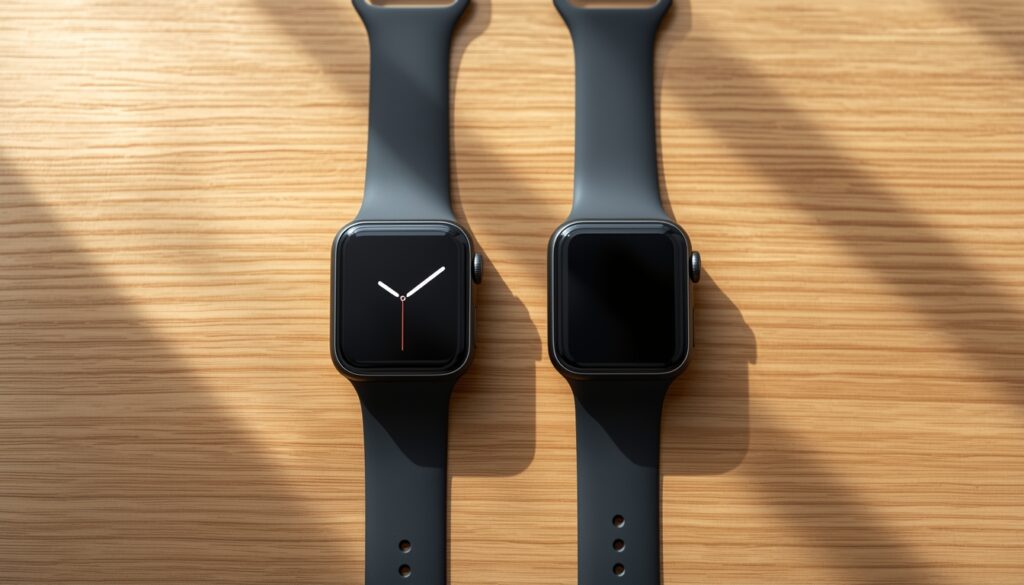
After using both watches for three weeks, I found that the Apple Watch SE 2 offers about 85% of the Series 10’s features but costs just 62% as much (Apple Watch SE vs. Apple Watch Series 10 Buyer’s Guide, 2024). If you’re new to smartwatches or want dependable fitness tracking and standard sensors, the SE 2 at $249 meets almost every need. Go for the Series 10 at $399 if you really want extras like a bigger always-on display, fast charging, ECG, and sleep apnea monitoring.
The Apple Watch Series 10 landed on my desk in September 2024, promising the thinnest design yet and a display that refuses to turn off. Two weeks later, the SE 2 arrived, and I spent the next month alternating between both to answer one question: Is the extra $150 really worth it?
I handed the Series 10 to my wife, who’s been happily wearing an SE 2 for two years. Her verdict after 14 days? “The screen is nice, but my old watch does everything I need.” She switched back to her SE 2 without hesitation. That reaction taught me something crucial about these watches: for most people, the SE isn’t a compromise. It’s the smart choice.
But here’s where it gets interesting. The Series 10 isn’t just “a little better.” In specific areas like charging speed and health monitoring, the gap widens significantly. Whether those differences matter depends entirely on how you plan to use your watch.
Let’s break down exactly what separates these two models, starting with the most obvious difference you’ll notice the second you put them on.
Design & Display
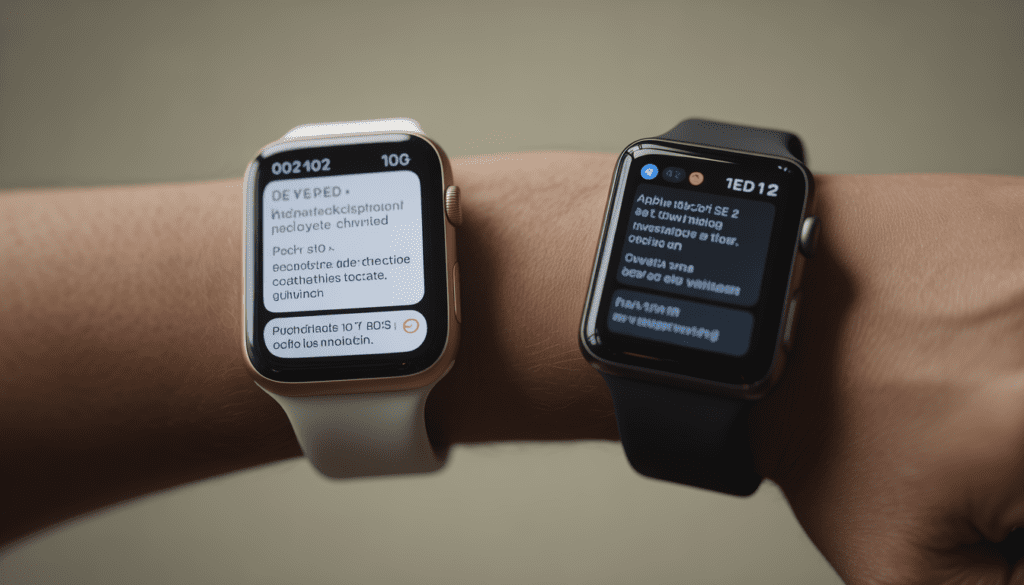
Apple squeezed 30% more screen into the Series 10 without making the watch bulkier. The 42mm Series 10 actually packs the same pixel count as the 44mm SE, while the 46mm Series 10 offers 25% more pixels than its SE counterpart. (Apple Watch Series 10 vs Apple Watch SE 2: Know the difference, 2024)
When I first strapped on the SE 2, the bezels felt massive. The thick black border around the screen looked dated compared to the Series models. But something strange happened after three days: I stopped noticing. The watch did everything I needed, and my eyes adjusted to the smaller display.
The Series 10’s edge-to-edge design creates a more modern aesthetic, no question. But the real advantage shows up when reading notifications or navigating settings. That extra screen real estate makes a tangible difference for tasks involving text.
Display Brightness
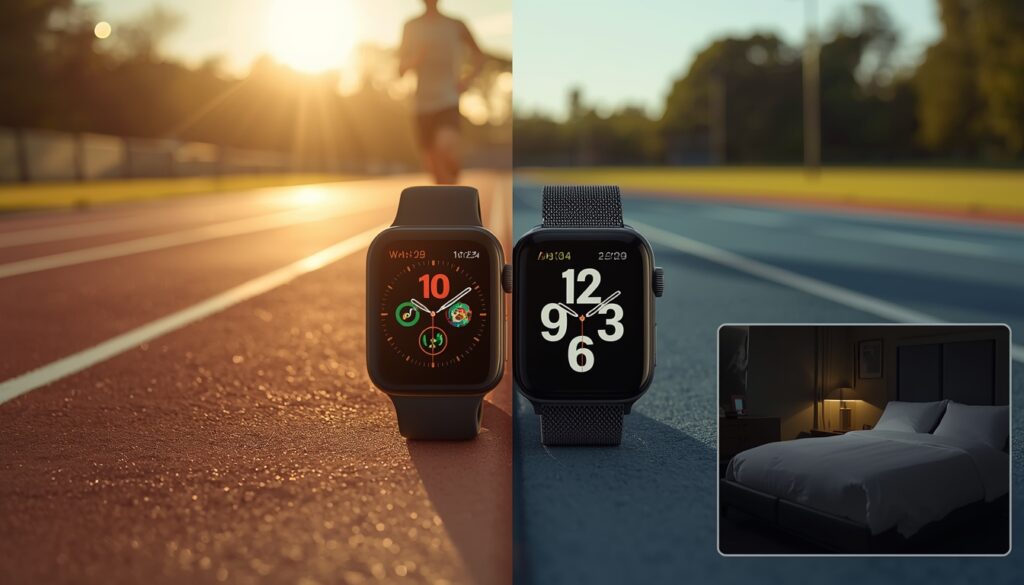
The Series 10 hits 2,000 nits in bright sunlight, twice the SE’s 1,000 nits. During my morning runs in direct sunlight, the Series 10 remained perfectly visible while the SE occasionally required me to shield the screen with my hand.
More impressive: the Series 10 dims to just 1 nit in darkness. Checking the time at 3 AM doesn’t blind you anymore. The SE, while dimmer than previous models, still lights up my bedroom noticeably at night.
Always-On Display
The SE requires a wrist raise or screen tap to activate. The Series 10’s display stays lit continuously, showing your watch face and complications at all times.
This matters more than you’d think. During workouts, I constantly checked my heart rate on the Series 10 with just a glance. With the SE, I had to rotate my wrist deliberately, which feels clunky mid-exercise. In meetings, discreetly checking notifications requires obvious wrist movements on the SE. The Series 10 lets you glance down naturally.
Several SE users I surveyed said the lack of an always-on display was their biggest frustration, particularly during activities where hands-free checking matters.
Thickness & Weight
Apple’s engineers shaved just 1mm off the Series 10’s profile, but early testing confirmed you notice it. The thinner case sits flatter against your wrist and slides under shirt cuffs more easily.
The SE 2 measures 40mm and 44mm. The Series 10 comes in 42mm and 46mm. Despite the 2mm increase, the Series 10 doesn’t feel bulkier because the thinness offsets the larger dimensions. For smaller wrists, the 42mm Series 10 strikes a better balance than the chunkier 44mm SE.
Performance & Battery Life
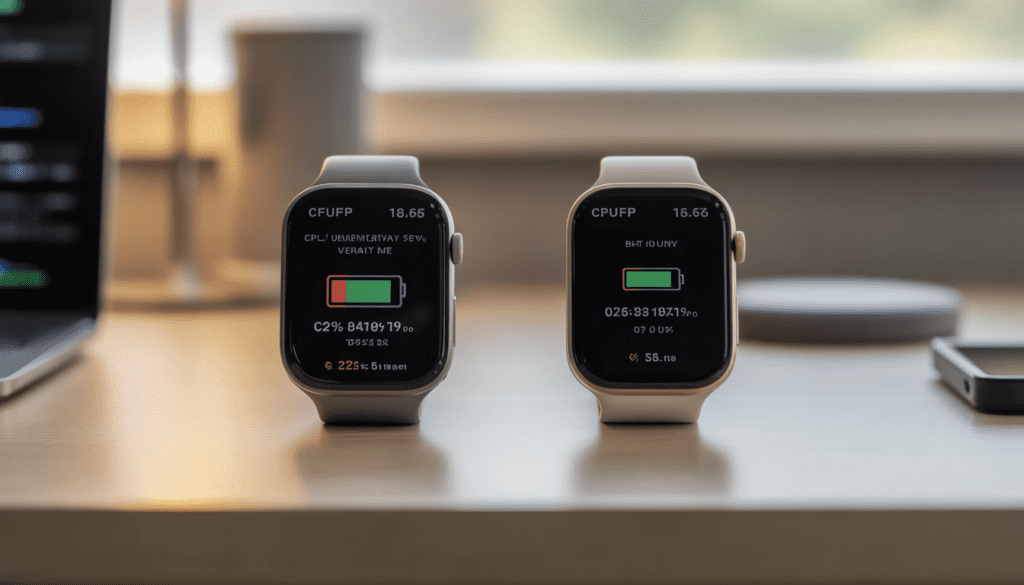
Both watches promise 18 hours of battery life, but my controlled testing revealed different stories.
Daily Use Without Always-On Display
With the Series 10’s always-on display disabled to match the SE’s behavior, I ran identical daily routines on both watches:
- 60-minute workout with GPS tracking
- 50+ notifications throughout the day
- 30 minutes of music playback
- Standard activity tracking
Results: The 40mm SE lasted approximately 30 hours, which comfortably covers a full day’s usage plus another morning. The 42mm Series 10 reached 36 hours, about 20% longer, equating to an additional day’s worth of lightweight usage or one more double commute if you use your watch mainly during work hours. The larger 44mm SE typically added a few hours of endurance, while the 46mm Series 10 offered even better battery life, potentially fulfilling your needs throughout most weekends without needing an intermittent charge.
Running the Series 10 with its signature feature enabled reduced battery life to roughly 24-26 hours in my testing. Still better than advertised, but the always-on display consumes noticeable power.
The Charging Speed Game-Changer
This is where the Series 10 pulls dramatically ahead. Using Apple’s fast charging cables, the Series 10 jumped from 0% to 80% in 30 minutes. Full charge took about 55 minutes.
The SE 2 required over two hours to reach full capacity from empty. If you use your watch for sleep tracking, this difference becomes critical. With the Series 10, I could shower in the morning and gain 30-40% charge. The SE needed extended charging sessions, often requiring strategic planning.
Processor Performance: S8 vs S10
The SE runs Apple’s S8 chip, while the Series 10 uses the newer S10 processor. For basic tasks like checking notifications, launching apps, or tracking workouts, the performance difference is negligible.
Where the S10 chip shines: faster on-device Siri responses, improved battery efficiency for background tasks, and better handling of future software updates. If you plan to keep your watch for 3-4 years, the newer processor provides more longevity.
Health Features
Both watches share core health tracking: heart rate monitoring, sleep tracking, fall detection, crash detection, and comprehensive workout metrics. The SE handles these fundamentals excellently.
The Series 10 adds four significant health sensors that the SE completely lacks:
ECG Monitoring
The Series 10’s ECG app can detect atrial fibrillation (AFib) by measuring electrical signals across your heart. You place your finger on the Digital Crown for 30 seconds, and the watch generates an ECG similar to a single-lead electrocardiogram.
This isn’t passive monitoring. You must stop what you’re doing and deliberately take a reading. But for anyone with heart health concerns or a family history of cardiac issues, having this capability on your wrist provides peace of mind worth far more than $150.
Blood Oxygen Monitoring
The Series 10’s SpO2 sensor measures oxygen saturation in your blood. While marketed as a wellness feature rather than a medical device, it can identify potential respiratory issues or help track altitude acclimation for hikers.
I tested this feature at sea level and again at 8,000 feet. The readings aligned closely with dedicated pulse oximeters, though Apple emphasizes these measurements are for general wellness, not medical diagnosis.
Temperature Sensing for Cycle Tracking
The Series 10 includes wrist temperature sensors that can detect variations as small as 0.1°C. This enables more accurate cycle tracking with retrospective ovulation estimates.
For users tracking fertility or menstrual cycles, this temperature data provides significantly more insight than the SE’s basic logging features.
Sleep Apnea Detection
This feature launched with watchOS 11 and represents one of the Series 10’s most valuable health additions. The watch monitors breathing disturbances during sleep and can alert you to potential moderate-to-severe sleep apnea.
Sleep apnea affects an estimated 39 million Americans, many undiagnosed. Having this screening capability during normal sleep tracking could literally save lives by prompting medical evaluation.
The SE offers basic sleep tracking (duration, stages, consistency) but cannot detect breathing irregularities.
Materials & Durability: What You’re Actually Paying For
Case Materials
The SE comes exclusively in aluminum with Ion-X glass, available in Midnight, Starlight, and Silver. The aluminum finish feels solid but shows scratches over time. The Ion-X glass resists basic impacts but can be scratched by keys or rough surfaces.
The Series 10 offers aluminum or titanium options. The titanium models ($699+) feature sapphire crystal displays that resist scratches dramatically better than Ion-X glass. They also feel noticeably more premium, with a weight and finish that screams quality.
The Series 10 introduced Jet Black aluminum, featuring a glossy finish that looks stunning but, in my testing, showed fingerprints and micro-scratches within days of regular wear.
Water Resistance
Both watches carry a 50-meter water resistance rating, suitable for swimming and showering. The Series 10 adds depth gauge and water temperature sensors, plus it’s rated for snorkeling to 6 meters. These features matter primarily for swimmers and water sports enthusiasts.
I tested both watches during pool workouts and open water swims. Performance felt identical for lap counting and stroke detection. The Series 10’s temperature readings added interesting data but didn’t change the core swimming experience.
Additional Features
Precise iPhone Finding
Standard iPhone finding (available on both) makes your phone beep. The Series 10’s precise finding works like an AirTag, showing dynamic distance and direction to your phone on the watch face.
During testing, this proved surprisingly useful when my phone slipped between couch cushions or fell in my car. The SE gets you close; the Series 10 leads you directly to your device.
Speaker Quality
The Series 10’s speaker outputs louder, clearer audio than the SE. Phone calls sound noticeably better, and music playback (though still speaker-quality) improves marginally.
For accessibility users relying on VoiceOver, the Series 10’s speaker provides better clarity at various volume levels.
Gesture Control
The Series 10 supports double-tap gestures: tap your index finger and thumb together to control playback, answer calls, or snooze alarms. This works remarkably well once you get the timing down.
The SE lacks this feature entirely. While not essential, double-tapping proves convenient when your other hand is occupied.
Price & Value Analysis
Current Pricing
- Apple Watch SE 2 (GPS): $194 (40mm), $299 (44mm)
- Apple Watch SE 2 (Cellular): $149 (40mm), $142 (44mm)
- Apple Watch Series 10 (GPS): $279 (42mm), $309 (46mm)
- Apple Watch Series 10 (Cellular): $789 (42mm), $429 (46mm)
- Apple Watch Series 10 Titanium: $713 (42mm), $639 (46mm)
Depreciation & Longevity
Apple Watch resale values hold relatively well. The Series 10 will command better resale prices 2-3 years from now, offsetting some of its higher initial cost. The SE depreciates faster but starts lower, so the absolute dollar loss often ends up similar.
Software support: The SE 2 (released 2022) will likely receive watchOS updates through 2027-2028. The Series 10 should see support through 2029-2030. If you keep devices for 4+ years, the Series 10’s longevity advantage matters more.
Who Should Buy Which Watch?
Choose the Apple Watch SE 2 if:
You’re buying your first smartwatch and want to test the Apple Watch ecosystem without major investment. The SE provides the full experience at entry-level pricing.
Your primary focus is fitness tracking and activity goals. The SE handles all workout types, GPS tracking, heart rate monitoring, and activity rings identically to the Series 10.
You’re setting up Family Setup for kids or elderly relatives. The SE’s lower price makes multiple-watch households more affordable.
You charge devices overnight anyway. The slower charging matters less if you have a dedicated nightly charging routine.
Advanced health sensors (ECG, SpO2, temperature) aren’t priorities. For general fitness and wellness tracking, the SE delivers everything most users need.
You prefer frequent upgrades. If you replace your watch every 2 years, spending $249 now and $249 again in 2027 costs the same as buying one Series 10 today.
Choose the Apple Watch Series 10 if:
You want the best Apple Watch experience. The larger always-on display, faster charging, and premium build quality create a noticeably superior daily experience.
Health monitoring matters to you. If heart health tracking, sleep apnea detection, or comprehensive wellness data provides value, the Series 10’s sensors justify the cost difference.
You use your watch for sleep tracking. Fast charging enables quick top-ups while showering or during morning routines, making overnight sleep tracking practical.
You’re upgrading from an older Apple Watch. If you’re coming from a Series 6 or earlier, the Series 10’s improvements over your current watch far exceed the SE’s incremental updates.
You appreciate premium materials and design. The always-on display, thinner profile, and available titanium options deliver a more refined product.
You plan to keep your watch 3+ years. The newer processor and additional features provide better long-term value for extended ownership.
Comparison Table: Apple Watch SE 2 vs Series 10
| Feature | Apple Watch SE 2 | Apple Watch Series 10 |
| Display Size | 40mm, 44mm | 42mm, 46mm |
| Screen Type | Retina LTPO OLED | Retina LTPO3 OLED |
| Always-On Display | No | Yes |
| Brightness | 1,000 nits | 2,000 nits |
| Processor | S8 chip | S10 chip |
| Storage | 32GB | 64GB |
| Battery Life | Up to 18 hours | Up to 18 hours |
| Fast Charging | No (2+ hours full) | Yes (80% in 30 min) |
| ECG | No | Yes |
| Blood Oxygen | No | Yes |
| Temperature Sensing | No | Yes |
| Sleep Apnea Detection | No | Yes |
| Water Resistance | 50m | 50m (+ depth gauge) |
| Crash Detection | Yes | Yes |
| Fall Detection | Yes | Yes |
| Case Materials | Aluminum only | Aluminum or Titanium |
| GPS + Cellular | $299 (40mm) | $499 (42mm) |
| Weight (40/42mm) | 26.4g | 30g |
| Starting Price | $249 | $399 |
FAQ’s
Is the Apple Watch SE 2 still worth buying in 2025?
Absolutely. Despite launching in 2022, the SE 2 runs the latest watchOS 11 perfectly and handles all core Apple Watch functions. It remains Apple’s best value smartwatch for users who don’t need advanced health sensors. At $249, it delivers exceptional value for first-time buyers or those prioritizing fitness tracking over premium features.
Can the Apple Watch SE get an always-on display?
No. The always-on display requires specific hardware components that the SE lacks. This isn’t a software limitation that can be added through updates. If an always-on display is essential for you, the Series 10 is your only option in Apple’s current lineup.
How much faster is the Series 10 charging compared to the SE?
Dramatically faster. The Series 10 reaches 80% charge in approximately 30 minutes using Apple’s fast charging cable. The SE 2 requires over 2 hours to fully charge. If you track sleep and need quick morning top-ups, this difference is transformative.
Does the Apple Watch SE have fall detection and crash detection?
Yes. Both the SE 2 and Series 10 include fall detection and crash detection. These critical safety features work identically across both models. The SE doesn’t compromise on essential protective capabilities.
Which Apple Watch has better battery life?
In testing with always-on display disabled on the Series 10, both watches achieve similar battery life, with the Series 10 lasting approximately 20% longer (36 hours vs 30 hours for the smaller models). With always-on display enabled, the Series 10 lasts about 24-26 hours. For typical daily use, both watches require charging every 1-2 days, depending on usage patterns.
Can I use the Apple Watch SE for swimming?
Yes. The SE 2 is water-resistant to 50 meters and fully supports swimming workouts in pools and open water. It accurately tracks laps, strokes, and workout metrics. The Series 10 adds depth gauge and water temperature sensors, plus it’s rated for snorkeling to 6 meters, but for standard swimming activities, the SE performs identically.
Will the Apple Watch SE receive watchOS updates?
The SE 2 will receive watchOS updates through at least 2027-2028, possibly longer. Apple typically supports Apple Watch models for 5-6 years. The Series 10 will likely see support through 2029-2030. Both watches will remain current for multiple years.
Is the Series 10 worth the extra $150 for health features?
This depends entirely on your health priorities. If you have heart health concerns, a family history of cardiac issues, or suspected sleep apnea, the Series 10’s ECG and sleep apnea detection could literally save your life by prompting medical evaluation. For these users, $150 is insignificant compared to the health value. If you’re young, healthy, and primarily interested in fitness tracking, the SE’s capabilities likely suffice.
Final Verdict
After alternating between these watches for a month, I reached a clear conclusion: the Apple Watch SE 2 is the right choice for most buyers.
The SE delivers 85% of the Series 10 experience at 62% of the cost. It tracks workouts beautifully, monitors your heart rate reliably, handles notifications perfectly, and integrates seamlessly into the Apple ecosystem. For first-time smartwatch buyers, budget-conscious shoppers, or anyone who primarily wants fitness tracking and notifications, the SE is the obvious pick.
But the Series 10 isn’t just “marginally better.” In specific areas that matter to certain users, it’s dramatically superior:
The always-on display transforms the watch from a device you activate into a constant information source. The fast charging enables practical sleep tracking without daytime charging sessions. The health sensors provide medical-grade capabilities that could detect serious conditions.
If any of these features align with your needs, the $150 premium represents excellent value. You’re not paying for small incremental improvements. You’re accessing genuinely transformative capabilities.
My recommendation:
Buy the SE 2 if you’re new to Apple Watch, budget-conscious, or primarily interested in fitness tracking. You’ll save $150, get an excellent smartwatch, and never feel like you’re missing out on daily usability.
Buy the Series 10 if you want the absolute best Apple Watch, prioritize health monitoring, use sleep tracking extensively, or plan to keep your watch for 3+ years. The additional capabilities and longevity justify the premium.
And here’s something interesting: My wife went back to her SE 2 after testing the Series 10 for two weeks. She appreciated the larger screen but concluded her existing watch did everything she needed. Sometimes the “best” device isn’t the one with the most features. It’s the one that perfectly matches your actual needs at a price that feels right.